
Certified Business
With over 10000+ orders
With over 10000+ orders
Ultrasonic cleaners are effective for removing paint when you are cleaning small parts (tools, carburetors, metal components, nozzles), the paint is aged, cracked, or partially deteriorated, and you combine the process with a proper ultrasonic cleaning solution.
If you’re trying to strip heavy-duty coatings off large surfaces, this isn’t the right tool. But for precision cleaning and light paint removal, it works surprisingly well. The key is to know how to use the ultrasonic cleaner for paint removal and when to do it.

Ultrasonic cleaners do not work like traditional paint strippers. Instead of chemically dissolving paint on its own, it uses high-frequency sound waves to create microscopic bubbles ( cavitation). These bubbles rapidly collapse against the surface of your object, loosening contaminants, including certain types of paint.
| Effectiveness Level | Paint Types and Conditions |
| Very effective | Thin coatings, acrylic paint, water-based paint, fresh paint, or already-damaged paint |
| Moderately effective | Spray paint or light enamel layers (with the right solution and time) |
| Less effective | Thick, baked-on, powder-coated, or industrial-grade paint |
When you use an ultrasonic cleaner for paint removal, your goal is to loosen and lift it safely without damaging the underlying material. That means combining the right solution, temperature, and time.
Start by selecting a solution that can soften or break down the paint. Ultrasonic waves alone cannot do much without the right cleaner. Stripping agents like Isopropyl Alcohol (IPA) and LA’s Totally Awesome Cleaner are best for ultrasonic paint removal.
Fill your ultrasonic cleaner with the solution and run it briefly (5–10 minutes) without any items inside. This process is known as degassing an ultrasonic cleaner, and it is especially important because it removes trapped air and allows the cleaner to work at maximum cavitation efficiency.
Wipe off grease, dirt, or loose debris from the item you intend to clean the paint off of. This allows the ultrasonic cleaner to focus directly on the paint layer. Some users advise trying to clean off some of the paint as gently as possible, so as to make the job easier.

Place the object in the basket (not directly on the tank floor). Using the basket is extremely important because you want all the parts of the item to be equally exposed to the solution. For ultrasonic paint removal, you definitely need an ultrasonic cleaner with a basket.
Turn on the heater, and heat the solution for about 10 minutes. Warm solutions (typically 40–60°C / 104–140°F) are generally better for ultrasonic paint removal: the heat helps soften the paint and also boosts chemical activity in the solution. With a warm solution, you get quicker results, and the overall cleanliness is much better.
Turn on the ultrasonic cleaner and let cavitation do its job. You should start to see paint loosening or flaking off.
You can run the ultrasonic cleaner for 10 minutes first, then pull out the baskets to assess how much paint has been taken off. Remove the item and check progress. Remember, you can run more sessions if necessary. Stubborn paint may require multiple cycles or a stronger solution.
Once the paint is removed, rinse the item with clean water and dry it completely to prevent corrosion. Consider coating it with oil if you do not intend to repaint it immediately.

The ultrasonic cleaner provides the mechanical action, but the appropriate ultrasonic cleaner solution does the chemical heavy lifting. If your solution can’t break down paint, the ultrasonic waves won’t magically compensate.
Here are four of the best ultrasonic cleaning solutions for paint removal:
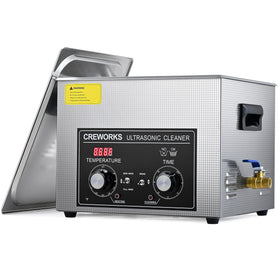
The ultrasonic cleaner you use must be of the right size and have both a degassing and a heat function. If the item is cramped or overcrowded, cavitation becomes uneven. A properly sized tank ensures consistent cleaning across the entire surface.
Do not fill your ultrasonic cleaner with undiluted isopropyl alcohol or other flammable solvents. Instead, fill the tank with water, and place the solvent in a separate container (like a glass beaker) inside the tank. This setup is safer and still effective.
Different types of paint require different approaches when it comes to ultrasonic removal. Remember, IPA for acrylic and water-based paints, Totally Awesome Cleaner for light paint and grime, Simple Green for lighter coatings, etc.
For larger, stubborn paint, consider combining ultrasonic cleaning with other methods for increased effectiveness. After running a cleaning cycle, for example, you can do a light manual scrubbing before running another cycle. This combination of different methods is far more effective.
Because you are using a warm ultrasonic cleaning solution, it is important to pay attention to heat damage. It is best not to expose sensitive materials to too much heat or long ultrasonic cleaning cycles. Always balance effectiveness with material safety.
Ultrasonic cleaning works in layers. Instead of forcing one long cycle, use short, repeated cycles for better results because they give you more control. You can assess as you go.
An ultrasonic cleaner can absolutely remove paint, but only under the right conditions. Remember, this is a precision cleaning system that works best when paired with the right solution and technique.
If you can approach it correctly, you’ll get cleaner results with less manual effort and better protection for delicate items. If you are mostly removing light to moderate paint, ultrasonic cleaning is one of the most efficient tools you can have.
Explore why ultrasonic cleaners remove abrasives and other substances that you can clean in an ultrasonic cleaner.



Leave a comment