
Certified Business
With over 10000+ orders
With over 10000+ orders
Because modern ultrasonic cleaners are so effective at removing dirt and contaminants from complex surfaces, it is natural to wonder whether they can also remove oxidation. The answer is: sometimes. It depends on the type of oxidation, how severe it is, and which cleaning solution you use.

An ultrasonic cleaner can remove certain types of oxidation, but not all oxidation. To understand why ultrasonic cleaners struggle with oxidation, it is important to understand the ultrasonic cleaner process.
The ultrasonic cleaning process works through a phenomenon called cavitation. Millions of microscopic bubbles form and collapse in the cleaning solution, creating tiny cleaning forces that reach into cracks, crevices, and hard-to-access areas.
In an off themselves, these bubbles are excellent at removing dirt, oils, grease, carbon buildup, surface contamination, and loosened oxidation products.
Ultrasonic waves themselves do not chemically dissolve oxidation. That is because oxidation is generally chemically bonded to the metal and requires a chemical reaction to be stripped away.
To tackle oxidation, an ultrasonic cleaner needs the right ultrasonic cleaning solution. When removing oxidation, the ultrasonic cleaner itself takes a secondary role, while the ultrasonic cleaning solution takes the primary role.
Here’s how it works: the process of cavitation assists the cleaning solution by continually exposing fresh metal surfaces and helping break away weakened oxidation layers.
Take silver tarnish, for example: Placing oxidized silver in just water and detergent will clean the dirt off, but the dark tarnish will remain. You must use a chemical dip or silver polish in conjunction with the machine.

So, whether oxidation can be removed by an ultrasonic cleaner does not depend on the strength or power of the ultrasonic cleaner itself, but on the potency of the ultrasonic cleaner used and how deeply it has bonded with the metal.
When paired with the appropriate cleaning solution, ultrasonic cleaners can successfully remove many forms of light to moderate oxidation.

The cleaning solution often determines whether oxidation removal succeeds or fails. Different oxidation types require different chemical formulations.
Ultrasonic rust removal cleaning solutions are specifically designed to dissolve iron oxide. You can use an oxidation and rust-remover solution (like diluted vinegar or Evapo-Rust) in the ultrasonic tank.
They work by removing oxidation because they chemically attack rust, while ultrasonic cavitation improves penetration. They are commonly used for steel tools, automotive parts, firearm components, and machinery parts.
Mild acidic ultrasonic cleaning solutions remove oxidation because they react with the oxide layer and help dissolve it from the surface.
Consider using acidic metal cleaners like these in your ultrasonic cleaner to remove copper oxidation, brass tarnish, and light oxidation on metal surfaces.

This is a professional-grade, ready-to-use, low-odor liquid specifically formulated for ultrasonic machines. It eliminates oxidation, tarnish, and stains from sterling silver in a single 1-to-3-minute cycle without requiring manual rubbing
Widely utilized in professional laboratory and industrial settings, a warm 2% dilution of this organic acid-based surfactant leverages mild chelation to dissolve silver oxide and tarnish safely.
Designed specifically for electronic and sonic bath applications like the Connoisseurs LaSonic Safewave Machine. It uses an ammonia-free formula to lift dullness and mild discoloration.
Silver cleaners are formulated to safely remove silver sulfide tarnish without damaging the underlying metal. They work for ultrasonic cleaners because the ultrasonic action allows the solution to reach intricate details and decorative features. They are commonly used for jewelry, silverware, and collectibles
Citric acid is a popular option for removing oxidation with an ultrasonic cleaner because it is relatively safe and environmentally friendly. It can help remove light rust, mild oxidation, and even mineral deposits. Many people choose citric acid when they want a gentler alternative to stronger chemicals.
These are designed for heavy-duty industrial cleaning applications. They can help remove oxide scale, corrosion deposits, and mineral buildup. These are highly effective, but also relatively costly and must be matched carefully to the metal being cleaned.
| Cleaning Solution | Best For | Examples | Why It Works |
| Rust-removal concentrate | Steel rust | Evapo-Rust, Diluted Vinegar | Dissolves iron oxide |
| Acidic metal cleaner | Copper and brass oxidation | Ultra-Power 132-B, diluted citric acid formulas, etc | Reacts with the oxide layer |
| Silver cleaning solution | Silver tarnish | iSonic Ultrasonic Silver Tarnish Remover, Connoisseurs All-Purpose Jewelry Cleaner Concentrate | Removes silver sulfide deposits |
| Citric acid solution | Light rust and oxidation | Alconox Citraonox, Crest Ultrasonic Chem-Crest Pro | Mild oxide dissolving action |
| Industrial descaler | Scale and heavy deposits | Breaks down stubborn mineral and oxide buildup |
| Type of Oxidation | Typically Removable? | Notes |
| Light surface rust | Yes | Usually removable with a rust-removal solution |
| Moderate rust | Often | May require extended cleaning cycles |
| Heavy rust scaling | Limited | Loose rust may be removed |
| Deep rust pitting | No | Metal damage is permanent |
| Silver tarnish | Yes | One of the easiest types to remove |
| Copper oxidation | Yes | Works best on light-to-moderate oxidation |
| Brass tarnish | Yes | Usually responds well to ultrasonic cleaning |
| Light industrial corrosion | Yes | Often removable with proper chemistry |
| Aluminum oxidation | Sometimes | Depends on the severity and the solution used |
| Severe corrosion damage | No | Physical metal loss cannot be restored |
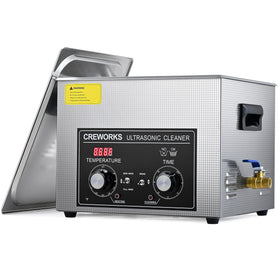
If oxidation removal is your primary goal, the ultrasonic cleaner matters almost as much as the cleaning solution. A good oxidation-removal ultrasonic cleaner should provide strong and consistent cavitation, adequate cleaning power, temperature control, sufficient cleaning time, and tank materials that resist chemical exposure
Creworks digital ultrasonic cleaners are designed to maximize the effectiveness of the cleaning solution while ensuring cavitation reaches every oxidized surface. Our ultrasonic cleaning machines efficiently clean a wide range of objects, including eyeglasses, timepieces, jewelry, toothbrushes, dental tools, and more. With a digital panel featuring a timer and temperature display, you can customize your cleaning for even the most delicate operations.
An ultrasonic cleaner can remove many types of oxidation, but it is not a universal solution for every corrosion problem. The ultrasonic waves themselves do not dissolve oxidation. Instead, they work together with specialized cleaning solutions to loosen and remove oxidized material from the metal surface.
For light rust, silver tarnish, copper oxidation, brass tarnish, and many forms of surface corrosion, ultrasonic cleaning can be remarkably effective. For severe rust, deep pitting, and advanced corrosion damage, however, ultrasonic cleaning can improve appearance but usually cannot restore lost metal.
Explore more on whether ultrasonic cleaners remove grease.



Leave a comment