
Certified Business
With over 10000+ orders
With over 10000+ orders
For cleaning a car carburetor, you generally need a 6-liter or larger ultrasonic cleaner. While a 3-liter unit is generally too small for anything beyond basic individual parts or tiny engine jets, a 6-liter ultrasonic cleaner offers the length and depth you need to fit larger components without awkwardly hanging them halfway out. However, if you plan to clean entire "banks" of motorcycle carburetors (like a 2-cylinder rack or 4-cylinder rack), it is best to size up to a 10L or 15L
For most hobbyists and automotive enthusiasts, a 6- to 10-liter ultrasonic cleaner represents the sweet spot for cleaning a carburetor. This size can typically accommodate motorcycle carburetors, ATV carburetors, UTV carburetors, Single automotive carburetors, and carburetor assemblies with floats and bowls removed.
A medium-sized tank provides enough space for cleaning while allowing the ultrasonic waves to circulate effectively around the component.

A good rule of thumb is to choose an ultrasonic cleaner whose tank dimensions are at least:
This extra space improves cavitation efficiency and allows the cleaning solution to circulate the entire component. If you are unsure, it is usually better to size up rather than buy a tank that is barely large enough.
Tank size matters, but the machine's performance features determine how well it removes deposits from tiny fuel passages and jets.
Heat dramatically improves the effectiveness of ultrasonic cleaning because it quickly softens fuel varnish, oil residue, grease, and carbon deposits. A heated ultrasonic cleaner reduces cleaning time, improves chemical effectiveness, and removes stubborn contamination.
For most carburetor cleaning applications, temperatures between 50°C and 60°C work exceptionally well, but look for a unit with a built-in heater that can reach 60°C to 80°C to be sure.
Ultrasonic frequency determines the size and intensity of cavitation bubbles. For carburetors, approximately 40 kHz is generally considered ideal because it provides a good balance between cleaning power, surface safety, and penetration into small passages.
Power determines how much cleaning energy reaches the carburetor. An underpowered machine may struggle with heavy varnish, oxidation, carbon buildup, and long-neglected carburetors. More power generally means faster cleaning and more effective penetration into complex internal channels.
Look for a unit with multiple transducers, industrial-grade power output, and a power density that is appropriate for its tank size. A larger tank should also have proportionally greater ultrasonic power.
Carburetor cleaning often involves chemicals, heat, and repeated use. A durable stainless steel tank provides corrosion resistance, long service life, easy maintenance, and better resistance to cleaning solutions. In short, stainless steel assures durability against harsh solvents and vibrations.
Different carburetors require different cleaning durations. Light contamination may need only 10–15 minutes, while heavily varnished carburetors may require multiple cleaning cycles.
Look for a unit with adjustable timer settings, digital controls, and multiple cycle options. This flexibility helps prevent over-cleaning while maximizing efficiency.
Understand ultrasonic degassing and why it matters.

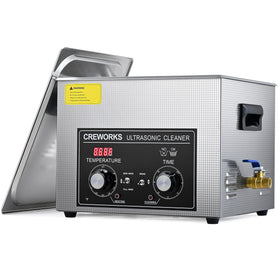
The 240W ultrasonic cleaner by Creworks is just the ultrasonic cleaner you need for an average-sized carburetor. Its 40kHz sound waves agitate the water in the 10L (2.6 gal.) basin, creating cavitation that thoroughly cleans your items without the need for harsh chemicals or radiation.
With enhanced 300W heating power, our ultrasonic cleaning machine provides even greater strength. The intuitive control panel allows for 1-30 minutes of timed cleaning and heated cleaning at temperatures between 32 and 176°F. Featuring degas and gentle cleaning modes, our ultrasonic parts cleaner ensures your cleaned items are protected while effectively removing dirt and grime.
The extra-thick tank lets you experience quieter operation with a 60 dB noise level. The ultrasonic cavitation machine's unibody 304 stainless steel basin and 4 non-skid rubber feet make for years of dependable performance.
Treat yourself to next-level cleaning with this professional ultrasonic cleaning machine today!
Always completely disassemble the carburetor and remove all rubber gaskets, O-rings, and diaphragms. Ultrasonic sound waves can easily destroy soft, pliable plastics and seals. Before cleaning, remove floats, jets, needles, gaskets, and all rubber components. Ultrasonic cleaning works best when the solution can access every internal passage, and disassembly also prevents damage to sensitive materials.
For carburetors, you generally need professional-grade, heavy-duty cleaning solutions, like Simple Green Pro HD, or manufacturer-recommended ultrasonic cleaning solutions. Specialized ultrasonic cleaning solutions help dissolve fuel varnish, oil residue, grease, and carbon buildup. Always follow the solution manufacturer's dilution recommendations.
Instead of filling a large 6L tank with expensive carburetor cleaner, fill the tank with plain hot water and put your parts into a Ziploc bag (or plastic bin) filled with your specific cleaning solution. The ultrasonic waves will still pass through the bag and clean the parts perfectly.
One of the most important safety rules is to avoid placing gasoline, acetone, or other highly flammable solvents directly into an ultrasonic cleaner. Ultrasonic energy and heated tanks can create dangerous conditions when used with combustible liquids. Instead, use solutions specifically designed for ultrasonic cleaning.
If the carburetor is covered in thick grease or dirt, remove the worst contamination before ultrasonic cleaning. This prevents premature solution contamination, reduces cleaning efficiency, and results in longer cleaning cycles. A quick brush-down can significantly improve results.
Once the cleaning cycle is complete, rinse with clean water if compatible with the cleaning solution, blow out passages with compressed air, and ensure all internal channels are clear. This step removes loosened debris and cleaning residues.
Dirty solution loses effectiveness over time. If you clean carburetors frequently, replace the solution when it becomes heavily contaminated. Fresh solution delivers stronger cavitation and better cleaning results.

For most carburetor cleaning applications, a 6- to 10-liter ultrasonic cleaner offers the best balance of capacity, versatility, and cost. Smaller 2- to 3-liter machines work well for lawn equipment and small engines, while 15- to 30-liter units are better suited for large automotive carburetors and professional shops.
Beyond tank size, prioritize features such as 40 kHz frequency, adjustable heating, adequate ultrasonic power, stainless steel construction, a quality basket, and digital controls. These features have a greater impact on cleaning performance than tank capacity alone.
When combined with proper cleaning solutions, careful disassembly, and good safety practices, an ultrasonic cleaner can restore carburetors more effectively and with far less effort than traditional manual cleaning methods.
You may also be interested in how to clean a carburetor fast and quickly in 5 simple steps.



Leave a comment