
Certified Business
With over 10000+ orders
With over 10000+ orders
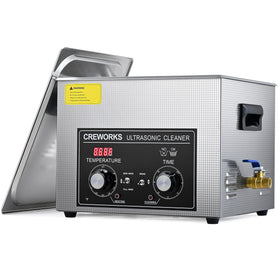
If you have been getting weaker cleaning results from your ultrasonic cleaner, longer cleaning cycles, and unnecessary frustrations, it may be because it needs to be degassed.
Understanding ultrasonic cleaner degassing is more important than most people realize. In fact, if you want your ultrasonic cleaner to maintain strong cleaning performance over time, work efficiently, and avoid reduced cavitation power, you need to know how and when to use the degas function.

To degas an ultrasonic cleaner simply means to remove trapped air and dissolved gases from the cleaning solution inside the ultrasonic tank.
Degassing becomes necessary because the water or cleaning solution with which you fill an ultrasonic cleaner inevitably contains dissolved air. More tiny air bubbles are also introduced as you pour and mix the liquid in the ultrasonic cleaner.
If not taken care of, these gases can interfere with the ultrasonic cleaning process and render the cleaning less effective. The purpose of degassing the ultrasonic cleaner is to eliminate unwanted gases before you start cleaning your actual items.
Ultrasonic cleaners work by producing cavitation bubbles: microscopic bubbles that form and collapse rapidly. When these bubbles implode, they create tiny but powerful shockwaves that remove dirt, oil, carbon buildup, and contaminants.
However, if the liquid is filled with dissolved air, that air absorbs ultrasonic energy. Instead of forming strong cavitation bubbles, the energy gets partially wasted.
So, degassing your ultrasonic cleaner does four things:
Think of it like clearing static from a signal. Once the air is removed, the ultrasonic waves can do their job properly.

The beauty of degassing an ultrasonic cleaner is that you don't have to do it yourself. All you have to do is locate the “degas” function and set it to “degas mode”.
When activated, the machine pulses ultrasonic waves in a pattern that encourages trapped air bubbles to rise to the surface and escape faster than during normal cleaning mode.
It’s basically a “prep mode” for your cleaning solution.
You should degas the liquid without any parts or objects in the tank. You’ll often see tiny bubbles rising to the surface during the process; that’s the trapped air escaping.
Degassing an ultrasonic cleaner can take 5-10 minutes, depending on the tank size. Most ultrasonic cleaners require:
Some machines have an automatic degas timer built in. If yours does, simply let the cycle complete.
A good rule of thumb is that when you no longer see a steady stream of small bubbles rising, the solution is properly degassed.

Degassing is especially necessary when:
Fresh liquid always contains dissolved gases. If you skip degassing, your first cleaning cycle will be weaker because the cleaner will spend part of that time naturally degassing the liquid anyway.
Using the degas function simply speeds up that process, so you get full cleaning power from the start.
Degassing may seem like a small step, but it has real performance benefits, from enabling stronger cavitation to faster cleaning times and an overall longer lifespan. Here are the five main benefits of degassing an ultrasonic cleaner:

You don’t need to degas every single time you turn the machine on, but it is always necessary to know when to degas an ultrasonic cleaner. Here are four clear signs that you need to degas your ultrasonic cleaner:
If you just added fresh water or solution, and you see lots of fine bubbles immediately when turning the machine on, your ultrasonic cleaner may need degassing. Fresh liquids contain dissolved gases. Always degas after refilling.
If the cleaning takes longer and the results are less effective, your ultrasonic cleaner likely needs degassing. The trapped air may be reducing cavitation strength, causing your items not to get as clean as before.
If your ultrasonic cleaner has been sitting unused for a long time, and you notice reduced performance at the start of a cycle, this is usually a sign that the machine needs degassing. When a cleaner sits for days or weeks, air can dissolve back into the liquid.
Any time you change the solution, you should degas. Freshly poured liquid with visible surface bubbles.

Degassing is not just an extra button: it’s a performance booster. Ultrasonic cleaners rely entirely on cavitation. Cavitation relies on proper energy transmission through liquid. Dissolved air interferes with that process. Degassing removes that interference and allows the machine to perform at full strength.
In short, degassing works because it prepares the cleaning solution to transmit ultrasonic energy efficiently. And when the energy is efficient, the cleaning is powerful. If you plan on using your ultrasonic cleaner long term, understanding and using the degas function isn’t optional; it’s essential.



Leave a comment