
Certified Business
With over 10000+ orders
With over 10000+ orders
Cleaning an ultrasonic cleaner is as much about ensuring the long-term performance of the entire device as it is about getting rid of the dirt and debris inside the tank. So, when you clean an ultrasonic cleaner, you must go through an entire process that involves removing contamination (which can reduce cleaning performance), preventing clogs and drainage issues, protecting sensitive components, and maximizing the lifespan of the machine.
The good news is that there are many ways to go about it, and the entire cleaning process becomes really straightforward if you know what areas require attention and how often they should be cleaned.
So, how do you clean an ultrasonic cleaner?

The whole process of cleaning an ultrasonic cleaner can be split into two parts:
The usual approach is to start by cleaning the interior of the ultrasonic cleaner (with warm water and the right detergent), then proceed to clean its drain hoses (usually by soaking). Starting by cleaning the interior of the ultrasonic cleaner not only removes dirt but also helps restore the machine’s efficiency. Cleaning the drain hoses helps take out stubborn grime.
Cleaning the basin is the first and most important step in cleaning an ultrasonic cleaner, and that is because the stainless-steel basin is the heart of every ultrasonic cleaner. It is where cavitation occurs and where contaminants tend to accumulate over time.
To clean it effectively, you must wash the tank and use effective (but safe) ways to get rid of the stubborn debris you will likely find in it. Follow these five steps:
Start by filling the tank with warm water and a few drops of mild dish soap or detergent. Make sure the detergent is sonic-safe before using. Dawn dish soap, for example, is perfectly fine.
Turn on the machine and let it run for 5–10 minutes with just the solution in it. This step is very important because it loosens built-up oils and debris, making the basin easier to clean.
Before cleaning the basin, unplug the machine and allow the liquid to cool if it has been heated. Then drain all the cleaning solution from the tank. Never leave an old solution sitting in the basin for extended periods, especially after cleaning heavily contaminated items.
 Step 3: Remove Loose Debris (Without Cleaning Solution)
Use a soft cloth, non-abrasive sponge, or paper towel to wipe down the interior of the basin. The objective here is to remove all loose sediment and visible contamination.
Pay special attention to the tank corners, drain openings, weld seams, basket support ledges, and the tank bottom. Many people are surprised by how much residue accumulates in these areas after months of operation.
Using a (new) solution of warm water and a mild detergent, thoroughly clean the interior surfaces. A soft microfiber cloth works well for routine cleaning, and that is what most people use. For stubborn buildup, however, you may need to use the non-abrasive sponge.
Most of the time, this step is not necessary, but if mineral deposits or chemical residues have formed, you need to allow warm water and mild detergent to soak in the basin for several minutes.
If you have been using tap water in your ultrasonic cleaner, there may be a lot of hard water scaling. Use a diluted vinegar solution to dissolve the mineral buildup. Make sure to rinse the tank thoroughly afterward to ensure no residue remains.
Use a clean microfiber towel to dry the basin and remove any soap residue. Leaving any kind of moisture in the tank for long periods can encourage corrosion around fittings, especially in environments with high humidity.

So, that is how you clean an ultrasonic cleaner tank in five steps. Even if you routinely replace cleaning solutions, residues gradually build up along the walls, corners, drain openings, and the bottom of the tank.
Oils, polishing compounds, grease, rust particles, dirt, carbon deposits, and cleaning chemicals can all leave behind deposits that affect performance.

If you have a larger professional ultrasonic cleaner and you clean a lot of items containing grease, sludge, rust particles, sediment, or polishing compounds, then cleaning the drain hoses has to be a very important part of cleaning and maintaining your ultrasonic cleaner.
Larger ultrasonic cleaners have drain valves and hoses that simplify fluid changes. However, over time, contaminants tend to collect inside these components and restrict flow. When a clog develops, draining the tank becomes slow or impossible.
Remove as much liquid as possible before working on the hose. This reduces mess and allows easier access to the drain system.
Many clogs occur directly at the drain valve rather than deep within the hose. Check for visible debris around the valve openings, screens, and internal passages. A small brush can often remove accumulations.
Disconnect the hose if the design allows, and run warm water through the hose in both directions. Back-flushing is especially effective because it pushes debris out from the opposite side of the blockage.
For stubborn clogs, use cotton pliers, flexible pipe brushes, drain cleaning brushes, or nylon cleaning rods to physically pull out the large chunks from the drain opening. These tools can break apart accumulated residue without damaging the hose. Avoid metal rods that may puncture or weaken flexible tubing.
Sometimes, poor drainage is not caused by a clog. The hose may have a lot of kinks, cracks, flattened sections, and chemical degradation, which means it is not in good condition.

If you are having trouble cleaning your ultrasonic cleaner hose, consider using what is described on Reddit as the “Bleach Soak Method.” It is an easy method where you prop the hose upward and fill it with pure bleach. The role of the pure bleach is to dissolve stubborn biological or organic buildup. Then you let it sit overnight and use a long, slim brush to scrub the inside of the tube and rinse it thoroughly.
Avoid using alcohol, acetone, or gasoline directly in the tank. The heat and vibrations can cause explosions. Always use the proper ultrasonic cleaning solutions. If in doubt, follow manufacturer recommendations.
An effective trick to keep your ultrasonic cleaning machine cleaner is to place smaller, dirty parts and your cleaning solution into a sealed Ziploc bag or glass mason jar. Then fill the main ultrasonic tank with plain water and suspend the bag inside. A lot of users agree that this keeps debris out of your machine’s basin and drain.
Whatever you do, do not scrub the delicate stainless steel interior with steel wool or abrasive powders. This will damage the cavitation surface.
Stuffing too many parts into the basket reduces cleaning efficiency and places additional strain on the system. Ultrasonic waves need space to circulate around objects.
Degassing an ultrasonic cleaner is more important than many people realize. Fresh solutions often contain dissolved air that interferes with cavitation. Running a degassing cycle improves cleaning performance and reduces unnecessary operating time.
Many users shorten equipment life by running continuous cleaning cycles far beyond recommended duty cycles. If the manufacturer recommends cooling periods, follow them.

While basic maintenance principles apply to all ultrasonic cleaners, all ultrasonic cleaners are not the same, and machine quality often determines how much maintenance is required and how easy that maintenance becomes.
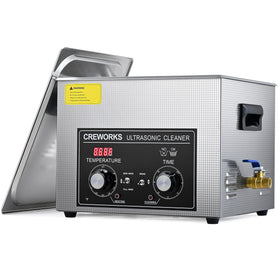
Creworks higher-quality digital, professional, and manual knob ultrasonic cleaners resist contamination more effectively, have components that last longer, and are overall less demanding when it comes to cleaning and maintenance.
With enhanced heating power and extensive cleaning times, you get thicker stainless-steel tanks, better weld quality, higher-grade transducers, and improved electronics with all models currently on offer.
Cleaning an ultrasonic cleaner is one of the simplest ways to protect cleaning performance and extend equipment life. Regular deep cleaning of the basin removes contamination that can interfere with cavitation, while maintaining drain hoses prevents frustrating clogs and drainage issues. Combined with proper operating habits, routine inspections, and the use of appropriate cleaning solutions, these maintenance practices can keep an ultrasonic cleaner operating efficiently for years.
You may also be interested in this guide on using tap water in an ultrasonic cleaner and whether it helps or hurts performance.



Leave a comment