
Certified Business
With over 10000+ orders
With over 10000+ orders
Ultrasonic cleaners can remove many types of abrasives, but not all of them. The process of cavitation, which is how ultrasonic cleaners work, is sufficient to remove loose or semi-adhered abrasives, but not deeply embedded abrasives.
During cavitation, the ultrasonic cleaner uses high-frequency sound waves to create microscopic bubbles in a liquid. When those bubbles collapse, they release tiny bursts of energy that:

This makes them extremely effective for loose or semi-adhered abrasives, especially when those particles are sitting on the surface or lightly embedded.
However, ultrasonic cleaning may not be sufficient if an abrasive is deeply embedded, chemically bonded, or fused into the material.
So think of ultrasonic cleaners as precision removal tools, not heavy-duty restoration machines.
Generally, ultrasonic cleaners are highly effective at removing loose abrasives, polishing compounds, and grit from intricate, hard-to-reach, or pitted areas. Here are some of the types of abrasives ultrasonic cleaners can remove:
An ultrasonic cleaner can be effective for invisible residual polishing from items like jewelry. These are usually abrasives mixed with binders (grease or wax) designed to remove scratches, smooth surfaces, and polish to a high luster. Cavitation breaks them apart easily because:
As long as your ultrasonic cleaner has adjustable temperature and is compatible with cleaning solutions designed for polishing residues, it should be capable of handling these.
An ultrasonic cleaner is also effective for handling abrasives like dust from sanding, grinding, or cutting. These particles are usually small and loosely attached, and they easily fall apart during cavitation.
With an ultrasonic cleaner with a higher frequency( for finer particles) and strong circulation or agitation, you should be able to remove dust and sanding particles effectively, with no brushing needed.
Another common type of abrasives that ultrasonic cleaners remove is metal shavings and debris, which is especially common in machining or manufacturing environments.
Ultrasonic cleaners work because these shavings are not typically bonded to the surface, and the energy from cavitation is able to dislodge them rather quickly.
For heavier debris, however, you may need a more powerful ultrasonic cleaning unit, preferably an industrial ultrasonic cleaner. Make sure it has a basket, so your items don't sit directly on the bottom of the tank.
Abrasives from lapping compounds, specifically those used in precision finishing, like valves or optical components, can be removed by an ultrasonic cleaner. First, the compound itself is pretty easy to remove, and so strong cavitation from an ultrasonic cleaner easily takes it out.
Removing lapping compounds, however, requires some degree of precision cleaning. So your ultrasonic cleaner must have fine-frequency operation and must be compatible with specialty cleaning solutions (which most are).

Again, ultrasonic cleaners do not remove all kinds of abrasive particles. As strong and precise as the cavitation process may be, many ultrasonic cleaners will struggle to remove solid, adhered coatings or embedded heavy grime on their own.
When the abrasive is embedded in rubber, plastic, or any other soft material, an ultrasonic cleaner will struggle to remove it.
That is mainly because the abrasive is physically lodged into the material, and cavitation cannot pull it out easily. In this case, mechanical cleaning or surface refinishing may be a better option.
If the abrasive has been fused onto a surface during high-heat processes, an ultrasonic cleaner will not be able to remove it. The residue is bonded at a molecular level, and ultrasonic energy isn’t strong enough to break that bond
You might want to consider chemical treatment or abrasive removal (ironically) for this one.
These are the kinds of abrasives common in industrial or outdoor environments. Ultrasonic cleaners generally cannot handle them because the oxidation creates a tough outer layer, and abrasives tend to get trapped beneath it.
What you need is an acid-based cleaner or some kind of descaling solution.
Ultrasonic cleaners also struggle with thick, abrasive buildup, like hardened grinding paste or compacted debris. The buildup makes it too dense for cavitation to penetrate effectively.
You may need to break up the mass first, and then preclean the material or soak it for some time before putting it in the ultrasonic cleaner.
| Abrasive / Residue Type | Can an Ultrasonic Cleaner Remove It? | Notes / Explanation |
| Loose sanding dust | Yes | Easily removed as particles are not bonded to the surface |
| Polishing compounds (light) | Yes | Especially effective with a proper cleaning solution |
| Buffing residue | Yes | Cavitation breaks down soft residue effectively |
| Grinding dust (fine) | Yes | Works well if particles are not embedded |
| Metal shavings (loose) | Yes | Quickly dislodged from small crevices |
| Lapping compounds (light use) | Sometimes | May require multiple cycles and a proper solution |
| Embedded abrasives | No | Ultrasonic waves cannot pull out particles embedded in the material |
| Heavy polishing compounds | Limited | Thick buildup may need pre-cleaning |
| Hardened abrasive residue | No | Requires mechanical or chemical removal first |
| Rust mixed with abrasives | No | Ultrasonic cleaners are not designed for rust removal alone |
| Sand embedded in soft metals | No | Can worsen surface damage if not handled carefully |
| Abrasive blasting media | Limited | Loose particles can be removed, but embedded media cannot |
When it comes to cleaning abrasives with an ultrasonic cleaner, technique matters just as much as the machine. The key to maximizing effectiveness is to use the right cleaning solution (like Simple Green or specialized cleaners) and combine it with heat to break down residues.
You must also be willing to pre-rinse where needed, and have the patience to run multiple cycles if you need to. Here are some top tips:

Plain water works for ultrasonic cleaners, but not very well when you are dealing with abrasives. Ultrasonic cleaning solutions reduce surface tension, and they help cavitation reach and lift particles more effectively
Use a solution designed for your material (metal, plastic, etc.)
Degreasers or surfactants help loosen particles
If there’s heavy buildup, don’t rely on ultrasonic cleaning alone. Start by rinsing or wiping off the loose debris. This will allow cavitation to focus on finer particles and prevent overloading the cleaner
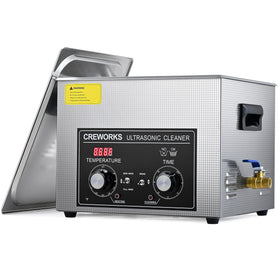
For cleaning abrasives, you need an ultrasonic cleaner with a heater that allows temperature control. Crework's professional ultrasonic cleaners, for example, have both a heater and a timer, so that you can heat the solution (typically 120–150°F) for many applications.
The heating helps soften the residues and improves the chemical activity of the cleaning solution
Cramming too many items reduces effectiveness. Space items out, and use the ultrasonic cleaner’s baskets or racks. These help ensure that proper cavitation goes around and reaches every item
Some abrasives won’t come off in one pass. After each clean, inspect the items, and repeat the cycles (usually about 10 mins), until you are satisfied with the cleaning. Gradual removal is often more effective than one long cycle
Don’t skip this step because it prevents the residue from redepositing. Rinse with clean water, and dry immediately (air or compressed air). The drying will also help prevent corrosion or spotting
 Final Thoughts on Ultrasonic Cleaners and Abrasives
Ultrasonic cleaners are incredibly effective for removing loose, fine, and surface-level abrasives, especially in hard-to-reach areas. They shine when precision matters.
But they’re not magic. If an abrasive is deeply embedded, fused, or chemically bonded, you’ll need additional methods.
If you match the professional ultrasonic cleaner, solution, and technique to the job, though, an ultrasonic cleaner can save you a ton of time and deliver results that manual cleaning just can’t match.
You may also be interested in ultrasonic cleaner degassing and what role it plays when dealing with harder materials.



Leave a comment