
Certified Business
With over 10000+ orders
With over 10000+ orders
If you are new to heat transfer printing, whether it’s HTV (heat transfer vinyl), sublimation, or transfer paper, one of the most confusing issues you would have to contend with is the varying opinions on whether you really need a heat press machine, and if you cannot just use a household iron for your work.
Each tool has its advantages. Each has limitations. And your results will depend heavily on which one you choose. If you are just getting started, you might not want to invest in a heat press right away. But you also don’t want peeling vinyl, faded prints, or ruined shirts.
Now, using an iron for heat pressing is actually possible, but understanding the difference between using an iron and a heat press can save you time, money, and frustration.

You can absolutely use a household iron for heat transfer printing, and, in certain situations, it works surprisingly well, and may be all you need.
The science behind why household irons work for heat transfer printing is rather simple. Heat transfer materials require three things: heat, pressure, and time.

While using an iron for heat transfer printing generally works for smaller projects, it is far from perfect. In fact, there are some real limitations of using an iron for heat transfer printing that can affect both the quality of your prints and the durability of your work.
Most household irons don’t maintain perfectly consistent heat and have hot and cold spots across the soleplate. They lack the hot, even surface of a press.
This is a problem because heat transfer materials require a consistent temperature across the entire design. If one section is cooler, that area may not bond properly, and it will most likely peel or lift later on.
What makes this problem worse is that, usually, you don’t notice it immediately. It shows up after washing.
Then there is the issue of pressure inconsistencies. With an iron, the pressure depends entirely on how hard you push.
During heat transfer printing, this can create two problems:
Professional heat transfers require firm, even pressure across the whole design. An iron simply can’t replicate the mechanical force of a press.
Though household irons have settings like “Cotton” or “Linen,” these are usually pretty vague, and in many cases, don't meet the level of accuracy required for heat transfer printing.
Heat transfer vinyl often requires very specific temperatures (like 305°F or 320°F). With most household irons (there are some good ones), you are mostly guessing, which leaves you open to risks. Too cool, and you get poor adhesion. Too hot and you get scorch marks or melted material.
Iron plates are relatively small and, even from a structural point of view, the fact that they are pointed at the tip is a setback for heat transfer printing.
If you’re applying large back designs, full-front graphics, or oversized logos, you have no choice but to press in sections. This increases the risk of uneven bonding, press lines, and overheating certain areas.
Household irons are also not ideal for sublimation. Sublimation requires precise temperature, even pressure, and an extensive, flat coverage. Even the best irons struggle to meet those requirements consistently. If sublimation is your goal, an iron is usually not the right tool.

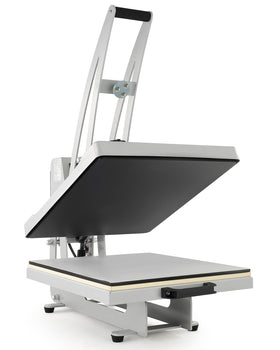
Contrary to a household iron, a heat press is a purpose-built tool. It is specifically designed to deliver even heat across a flat platen, consistent, measurable pressure, accurate temperature control, and precise timing.
The greatest difference between using an iron and a heat press comes down to control and consistency. Once you set it, the heat press repeats the same conditions every time, and that consistency is everything when it comes to obtaining good quality results.
With irons, you may struggle and have to guess sometimes, which can be costly, especially for larger projects.
A household iron simply cannot compare with a heat press when it comes to professional-level results, large designs, sublimation, and batch printing.
| Feature | Iron | Heat Press |
| Temperature Control | Basic, not precise | Digital, precise control |
| Heat Distribution | Uneven, hot spots | Even across the platen |
| Pressure | Manual, inconsistent | Adjustable and consistent |
| Best For | Small hobby projects | Professional and bulk production |
| Large Designs | Difficult | Easy |
| Sublimation | Not ideal | Excellent |
| Cost | Very low (household item) | Higher upfront investment |
| Consistency | Varies | Highly consistent |
Not everyone needs one, but in certain situations, it is wiser to spend the extra money and go for a heat press. Consider investing in a heat press if
If you’re running a small business or Etsy shop, consistency matters. A heat press will reduce product failures, improve durability, and protect your reputation.
If you are doing larger designs, even if it is for personal use, a heat press handles full-front, oversized, and complex graphics easily. An iron makes large designs stressful and unpredictable.
Sublimation requires precise, even heat. A heat press ensures you get those vibrant colors, full ink transfer, and clean edges. If sublimation is a large part of your work, a heat press isn’t optional: it’s essential.
If you love what you do and value overall efficiency, you will never regret putting in those extra bucks and getting a heat press. It just makes things easier: production is quicker, there is no guesswork, and you don't have to rework and rework.
If you want your results to look professional, and maybe you fancy yourself taking your craft to the professional level one day, a heat press is a wise and worthy investment. It will instantly fix those problems you have with peeling corners, faded prints, uneven adhesion, etc.
The Creworks12x15 Inch Heat Press Machine has a 12x15-inch heat pad that will let you easily and safely add your design from heat transfer or sublimation paper and vinyl to fabric, ceramic, and other mediums.
With this machine, you can add your own images to T-shirts, dresses, phone cases, and school bags. This press also comes with 7 other attachments, offering you more possibilities to create your own products, such as various sizes of mugs. Sell gifts like pillow cases, plates, caps, baby onesies, decorative tiles, and even coasters.

So, can you use an iron instead of a heat press? Yes, especially for small, simple, personal projects. But working with an iron is a workaround. A heat press is, by far, a better solution.
If you’re just experimenting, an iron is perfectly fine. But if you’re serious about quality, durability, or selling products, a heat press quickly becomes worth the investment. The key is understanding your goals.
Consider our complete guide on how to use a heat press machine.



Leave a comment