
Certified Business
With over 10000+ orders
With over 10000+ orders
The standard time for cleaning jewelry in an ultrasonic cleaner is about 3-5 minutes. However, it does not apply to all types of jewelry. Three factors determine how long you should clean your jewelry in an ultrasonic cleaner: the type of jewelry it is, how dirty it is, the kind of material it is made of, and how powerful your ultrasonic cleaner is.
In my experience, whenever people ask how long they should clean their jewelry in an ultrasonic cleaner, they usually expect a definite answer, like 4 minutes or 10 minutes. But that is not the case: not all jewelry is the same.
So, here is a detailed breakdown of how long jewelry should typically be cleaned in an ultrasonic cleaner, what factors affect cleaning time, and how to get the best results safely.

The standard duration to clean rings and common everyday jewelry in an ultrasonic cleaner is 3-5 minutes. For most types of jewelry, around 5 minutes works well for regular maintenance cleaning. This is widely regarded as the standard time because it applies to most kinds of jewelry, all things being equal. However, there are exceptions depending on how delicate the jewelry is and how dirty it is.
Generally, shorter cleaning cycles (3-5 minutes) are ideal for delicate jewelry or jewelry that is only slightly dirty, or has delicate plating or finishes. For example, lightly worn gold rings with minimal buildup may only need 2–4 minutes. Shorter cycles also reduce unnecessary stress on stones and settings.
Longer cleaning cycles (10-20 minutes) are best for super dirty jewelry, which has deep engravings and patterns that have accumulated dirt and dust, or has been worn for a long time without cleaning. A ring worn every day for months without cleaning may need 10–15 minutes, ideally split into multiple shorter cycles.
| 3-5 Minutes | 10-20 Minutes |
| Delicate jewelry | Jewelry with heavy grime buildup |
| Soft gemstones | Pieces exposed to lotions, sunscreen, or cosmetics |
| Antique pieces | Chains with trapped dirt |
| Jewelry with glued components | Rings worn daily for a long time |
| Jewelry with thin plating or finishes | Jewelry with deep engravings and intricate patterns |
| Jewelry that only has light dirt or fingerprints | Tarnished metal pieces |
| Items cleaned infrequently |
Take note that it is not advisable to run an ultrasonic cleaner for jewelry for 20 straight minutes. To avoid damaging your jewelry, do not exceed 10 minutes in a single session. Instead of running one extremely long cycle, it is usually safer to run one cycle of about 10 minutes, inspect the jewelry, rinse it, then repeat if needed.

Again, not all jewelry cleans at the same speed. There are several important factors you must keep in mind when determining how long to clean any kind of jewelry in an ultrasonic cleaner, and they often revolve around what kind of jewelry it is, how dirty it is, and what machine you are using. Here are 7 of the most important factors to consider:
The dirtier the jewelry, the longer you should run the ultrasonic cleaner for. The reason for this is quite simple: thick buildup reduces how efficiently and how quickly the ultrasonic waves are able to reach the surface underneath.
So, if body oils, soap residue, lotions, makeup, and dust have formed a stubborn layer over time on your jewelry, you need to leave it in the ultrasonic cleaner for longer.
Very dirty jewelry sometimes benefits from a quick soft-brush scrub before ultrasonic cleaning.
Jewelry is made of different kinds of metal, and some of those metals tolerate longer ultrasonic cleaning better than others.
Thin plating can gradually wear down if exposed repeatedly to long cleaning cycles.
Gemstones are one of the biggest factors affecting ultrasonic cleaning duration. Some stones are extremely durable, while others are porous, fracture-filled, heat-sensitive, or easily damaged by vibration.
 4. The Design Complexity of the Jewelry
Intricate jewelry takes longer to clean because dirt gets trapped in tight spaces. Think of chains, filigree, pavé settings, engraved jewelry, and multi-stone settings: ultrasonic cleaners are excellent for these designs, but more trapped debris means more cleaning time may be needed. The intricate designs mean you have to add about 3-8 minutes of cleaning time.
Jewelry cleaned regularly needs less time because the routine maintenance prevents heavy buildup from forming. In fact, regular cleaning is usually safer than occasional aggressive cleaning sessions.
More powerful ultrasonic cleaning machines clean faster. Professional ultrasonic cleaners typically generate stronger cavitation than small entry-level consumer units. In fact, a strong, professional ultrasonic cleaner reduces jewelry cleaning time by several minutes
Small low-power units have higher frequencies and are gentler but may clean more slowly, which means you likely require longer cycles to get good results.
A good jewelry-specific ultrasonic cleaning solution breaks down oils and grime much faster than plain water. With a proper ultrasonic jewelry cleaning solution, you can clean your jewelry within the standard cleaning time, which is 3-5 minutes for most jewelry. However, if you are using water only, you will require more cleaning cycles, which takes longer. Using the wrong chemical solution can damage jewelry, so always check compatibility first.
Crework's ultrasonic jewelry cleaner solution is specially made for gold and silver jewelry. It is formulated with precision and care, and it penetrates deep into every nook and cranny, thoroughly blasting away dirt, grime, and tarnish. It is also gentle on both your belongings and the environment, its non-toxic and pH-neutral formula ensures no harm comes to your delicate jewelry, gemstones, metals, or your loved ones.
| Factor | Effect on Cleaning Time |
| Light dirt | Reduce to 2–5 minutes |
| Heavy grime buildup | Increase to 10–20 minutes |
| Durable stones (diamond, sapphire) | Standard 5–10 minutes |
| Delicate stones (opal, pearl, emerald) | Reduce to 1–3 minutes or avoid |
| Intricate designs | Add 3–8 minutes |
| Routine cleaning | Shorter cycles needed |
| Long time between cleanings | Longer cycles needed |
| Professional ultrasonic cleaner | Reduce cleaning time |
| Weak consumer cleaner | Increase cleaning time |
| Proper cleaning solution | Faster cleaning |
| Water-only cleaning | Slower cleaning |
A good ultrasonic cleaner for jewelry does one thing perfectly: it cleans effectively without being overly aggressive. In other words, it provides enough cavitation power to remove dirt while still allowing precise control over cleaning cycles.

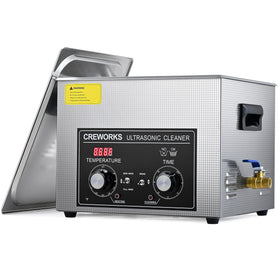
The 60W Ultrasonic Cleaner with Digital Timer and 100W Heater offers a combination of power and precision that makes it ideal not just for jewelry and other valuable items like watches, glasses, and even retainers.
The 60W power ensures that the cleaning process is quick and efficient. It is durable and suitable for individuals who plan on using the cleaner regularly, whereas its 2L tank size allows you to clean multiple pieces in one go.
Its features include a built-in heater and timer. The heat helps to loosen stubborn dirt and grime more effectively, while the timer ensures that your items are not left submerged for too long. The heater can reach up to a temperature that helps dissolve buildup more efficiently, which guarantees a thorough clean each time.
The CREWORKS Ultrasonic Cleaner with Heater and Timer is the go-to choice if you are looking for the best ultrasonic cleaners on the market.
The mistake many people make when cleaning jewelry in an ultrasonic cleaner is that they assume longer cleaning automatically means better results. That is not always the case. Timing is extremely important when using an ultrasonic cleaner for jewelry.
Intense vibrations can rattle stones, causing them to rotate or even fall out of their settings, particularly for pave or tension-set designs. This is especially risky for:
Even durable diamonds can fall out if the setting is compromised.
Never use an ultrasonic cleaner for organic or soft stones such as pearls, opals, emeralds, or jade. They can be permanently damaged by the vibration or heat. Soft or porous gemstones may crack, discolor, or worsen internally from prolonged ultrasonic exposure. Emeralds are especially vulnerable because many contain internal fractures and oil treatments.
Do not use the ultrasonic cleaner too frequently on your jewelry. Long-term or excessive use can eventually weaken prongs or cause claws to crack. Gold-plated and rhodium-plated jewelry can gradually lose its finish from repeated long cleaning sessions.

Using the ultrasonic cleaner properly matters just as much as choosing the right cleaning time. Here are some practical tips for better results.
Always use a jewelry-safe ultrasonic cleaning solution. Even if you cannot find a dedicated ultrasonic cleaner for jewelry, use warm water with a few drops of dish soap (like Dawn) and, optionally, a splash of ammonia for extra shine on gold and diamonds. This has been known to work. But, avoid harsh household cleaners unless specifically approved.
Jewelry pieces should not be packed tightly together. Do not place the jewelry directly on the metal bottom of the tub; use the basket or suspend the items with a hook to protect both the jewelry and the machine's transducer.
Always check that stones are still secure immediately after the cycle ends. Look specifically for any loose stones, cracked gems, weak prongs, or damaged settings. Ultrasonic cleaning can worsen existing problems.
 Final Thoughts on Cleaning Jewelry in an Ultrasonic Cleaner
In summary, ultrasonic cleaning takes about 3 to 5 minutes for most jewelry, under normal circumstances. With heavily soiled pieces, you sometimes need up to 20 minutes. However, the most important thing to keep in mind is that the ideal cleaning time depends on several factors, including the jewelry material, gemstone type, level of dirt buildup, cleaner power, and overall condition of the piece.
Remember, the goal is not to clean jewelry for the longest possible time. The goal is to clean it effectively while minimizing unnecessary wear and stress. Explore more on how to use an ultrasonic cleaner for jewelry.



Leave a comment