
Certified Business
With over 10000+ orders
With over 10000+ orders
An ultrasonic cleaner can be an excellent choice for removing grease from your tools and vehicle parts simply because the cavitation bubbles it produces lift grease away, even from hard-to-reach areas. However, removing grease with an ultrasonic cleaner is not just as simple as putting the item in and waiting a few minutes: you have to use the right cleaning solution, and the ultrasonic cleaner itself must be able to produce sufficient heat.
So, how exactly do you maximize grease removal with an ultrasonic cleaner, and what kind of ultrasonic cleaner works best for removing grease?
 Ultrasonic Cleaner Removing Grease: Why It Works
In and of itself, any decent ultrasonic cleaner can remove grease effectively. In fact, in many situations, they remove grease faster and more thoroughly than manual scrubbing, especially when the grease is hiding in small openings, grooves, threads, or complex parts. That is thanks to the process of cavitation, which is how an ultrasonic cleaner is also able to remove abrasives and paint.
Inside the cleaning tank of an ultrasonic cleaner, there are ultrasonic transducers that generate extremely high-frequency sound waves through the cleaning liquid. These sound waves create microscopic bubbles throughout the solution, which form and collapse continuously.
When these tiny bubbles collapse near an object's surface, they create localized bursts of energy, and this process (cavitation) dislodges contaminants, breaks contamination away from surfaces, reaches tiny crevices, and helps cleaning solutions penetrate hard-to-reach areas
Because grease often accumulates in inaccessible places, an ultrasonic cleaning has a major advantage over brushes or wiping.
 How to Use an Ultrasonic Cleaner For Removing Grease
One of the most effective ways to remove grease with an ultrasonic cleaner is what users call the “double boil method”.
To keep your machine's main water tank clean, put your parts inside a glass jar or a sealed Ziploc bag filled with a specialized degreaser. Then submerge the bag/jar in the water-filled tank. This method safely transmits the ultrasonic vibrations while preventing grease and chemicals from contaminating the machine's primary basin.
When it comes to removing grease with an ultrasonic cleaner, plain water alone will not lift grease efficiently. For optimal grease removal, use a dedicated ultrasonic cleaning solution, surfactant, or degreaser in the water. This way, the cavitation bubbles mechanically loosen the grease, while the chemical emulsifies it so it stays suspended in the water and does not restick to the part.
Set the heat to about 50°C to 60°C. High heat melts and loosens heavy factory grease much faster. The heat function is crucial when it comes to heat removal with an ultrasonic cleaner.
 To What Extent Can an Ultrasonic Cleaner Remove Grease?
An ultrasonic cleaner can effectively remove light oil films, surface grease, machine oils, fresh lubricant residue, moderate buildup, and grease trapped in small features. In many cases, parts emerge completely clean.
However, extremely heavy grease deposits are a different situation. An ultrasonic cleaner may struggle with thick, hardened grease, multi-year buildup, carbonized grease, caked industrial residue, and heavy sludge.
In these cases, ultrasonic cleaning may still be helpful in that it can loosen and remove much of this contamination, but you might need longer cleaning cycles and specialized detergents. You can also try pre-soaking the items or cleaning them manually first, before putting them in the ultrasonic cleaner.
If the item is coated in thick grease, wipe off the largest buildup first. Removing excess contamination prevents the ultrasonic cleaning solution from being contaminated quickly, improves cleaning efficiency, and helps cavitation reach the innermost surfaces. Do not force the machine to process large grease masses unnecessarily.
Use a cleaning liquid designed for degreasing. The solution should match the type of material being cleaned, the extent of contamination, and the purpose of cleaning. Choosing the wrong chemistry often limits results.
| Level of Grease | Recommended Solution | Common Uses |
| Light Grease | Distilled water, mixed with a few drops of dish soap. (Like Dawn Dish Soap) | Cleaning grease from jewelry, eyeglasses, and light tools |
| Heavy/Heavy Industrial Grease | Water-based alkaline degreasers like Simple Green, Purple Power, or SuperClean. | Cleaning grease on carburetors, bike chains, engine brackets, firearms, etc |
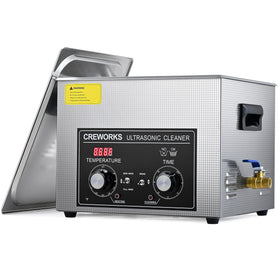
The best ultrasonic cleaners for grease removal have a heating function. Turn on the heating function, and allow the tank to reach operating temperature before cleaning. Warm liquid generally improves grease removal.
To degas an ultrasonic cleaner means to get rid of the dissolved air within the tank. Freshly filled tanks often contain dissolved air. So, run the machine briefly before adding parts. Degassing improves cavitation efficiency.
Never place items directly on the bottom of the tank. Direct contact can reduce cleaning performance, interfere with ultrasonic wave distribution, damage components, and stress the transducers. Suspended cleaning works better.
Crowding too many parts together creates shielding effects. Ultrasonic waves need room to circulate objects. Spacing improves results.
Once grease removal is complete, rinse the parts, remove detergent residue, and dry thoroughly. Leaving residue behind can create new issues.
 What Role Does Ultrasonic Cleaner Quality Play?
The quality of the ultrasonic cleaner affects grease removal more than many people realize. Two machines may appear similar on paper but produce very different results. In simple terms, you want an ultrasonic cleaner with sufficient cleaning power, a large tank, a heating function (to heat the cleaning solution), and a basket to place the items in.
 Final Thoughts on Removing Grease with an Ultrasonic Cleaner
Grease removal is one of the areas where ultrasonic cleaning often shines. The combination of cavitation, cleaning chemistry, and heat allows ultrasonic systems to clean areas that manual methods struggle to reach.
The key is understanding that success depends on more than simply dropping a greasy part into a tank and pressing a button. The cleaning solution, temperature, machine quality, frequency, and operating technique all work together. Use the right setup, and an ultrasonic cleaner can become one of the most effective grease-removal tools available. You may also be interested in how to remove paint with an ultrasonic cleaner.



Leave a comment