
Certified Business
With over 10000+ orders
With over 10000+ orders
If your moisture problem is moderate to severe, and especially if it threatens your building’s structure, equipment, or air quality, then a commercial dehumidifier is precisely what you need, and if you get a solid unit, it will totally be worth the money.
Commercial dehumidifiers offer faster moisture removal, are better suited for long-term use, and are capable of delivering reliable performance even in cold or challenging environments where many regular units would break down.
Also, unlike residential units, a commercial dehumidifier is designed to solve moisture problems, not just reduce them.
In this guide, we’ll walk through what makes commercial units different, how to choose the right one for your space, what they cost to rent or buy, and whether investing in one is truly worth it.

Commercial dehumidifiers are heavy-duty dehumidifiers that are specially designed with more powerful components like powerful compressors and condenser coils, advanced drainage options, LGR (Low Grain Refrigerant), heavy-duty filtration, and other features to allow them to extract larger volumes of moisture from the air quickly and reliably.
In short, commercial dehumidifiers are built for durability, speed, and extreme moisture control: unlike regular dehumidifiers, which are built to ensure comfort.

The first step to choosing the best commercial dehumidifier for your space is to understand that commercial dehumidifiers come in different types, and each type has particular features that make it most suitable for a specific kind of space.
If you cannot match the type of commercial dehumidifier to its ideal environment, it will not deliver an optimal performance, no matter how great the features are or how much it costs.
A crawl space dehumidifier is specifically built to work in tight, low-clearance areas and handle higher moisture loads than regular household dehumidifiers.
The specific purpose of a crawl space dehumidifier is to pull excess moisture out of the air, which in turn helps prevent mold, wood rot, musty odors, pests, and structural damage
So, they basically just sit in the crawl space, control moisture levels, keep the home healthier, and reduce long-term repair costs.
The best crawl space dehumidifiers have a low-profile design that allows them to fit and sit in tight spaces.
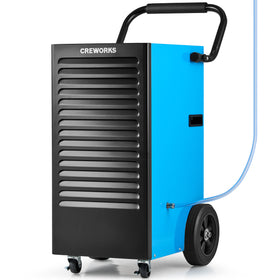
With an increased water removal capacity of 180 PDD and a sleek design that fits perfectly into your space, the 130 PPD Commercial Dehumidifier from Creworks is one of the best crawl space dehumidifiers.
It comes with the following features, which are all very important when you are looking for the best dehumidifier for your crawl space:
It is easy to install, features a detachable display panel that ensures easy adjustment of the timer, humidity levels, and modes.
Basement dehumidifiers are designed to reduce moisture in basements. They are typically stronger and more durable than portable units, and the best units come with larger water removal capacities, continuous drainage options, and built-in ramps
When it comes to basement dehumidifiers, the most important feature is water removal capacity. The best dehumidifiers for basements can remove up to 70–120+ PPD. Creworks 145 PPD Commercial Dehumidifier with Auto Defrost is considered to be the best dehumidifier for basements, and it reaches180PPD.
Portable, upright commercial units work well in most basements.
Warehouse dehumidifiers are perhaps the most formidable types of commercial dehumidifiers, as they typically can remove up to 150-300+PPD. They are usually portable (with rugged wheels and handles), and almost always have an integrated pump.
Large commercial spaces, manufacturing floors, and storage warehouses require serious moisture control to protect inventory and equipment.
When it comes to the best warehouse or industrial dehumidifier, the most important feature to look for is water removal capacity. A good industrial dehumidifier is Crework’s 180 PPD Commercial Dehumidifier with Auto Defrost, which is capable of up to PPD per day.
These units often run 24/7 and must be durable.
 How a Commercial-Grade Dehumidifier Works
A commercial dehumidifier works in the same way a regular dehumidifier works: it eliminates moisture from the air by pulling humid air across cold coils, causing moisture to condense into water, which is then collected or drained away.
However, that’s where the similarities end. A commercial-grade dehumidifier is different from a regular dehumidifier in that, though it does basically the same thing, it is capable of doing it on a much larger scale, and in much quicker time and for much longer periods.
A commercial dehumidifier uses a significantly more powerful, efficient, and durable system to remove far more moisture much faster than any residential unit.
| Feature | Residential Dehumidifiers | Commercial Dehumidifiers |
| Power & Moisture Removal | Smaller compressors; slower, light-to-moderate moisture removal | Larger compressors and coils; removes much more moisture quickly |
| Airflow | Low (100–150 CFM) | High (250–500+ CFM) for fast processing of large volumes |
| Technology | Standard refrigerant; no LGR | Often uses LGR for extreme humidity and cold conditions |
| Duty Cycle | Part-time use; not built for 24/7 | Continuous, heavy-duty operation |
| Drainage | Buckets or basic gravity drains | Built-in pumps, continuous drainage, high-capacity systems |
| Performance in Harsh Conditions | Struggles in cold or very damp areas | Excels in cold, wet, or harsh environments; reinforced and sensor-equipped |
A common dilemma homeowners face is whether it is more cost-effective to buy a commercial dehumidifier or just rent one and use it for a time. The best way to arrive at a suitable decision is to evaluate the costs and benefits of renting vs buying a commercial dehumidifier.
On average, renting costs for a commercial dehumidifier:
Renting a dehumidifier makes sense if you have a temporary issue, you’re dealing with one-time water damage, or you only need it for a short project (1–4 weeks)
A smart approach to renting a commercial dehumidifier is to rent it on a weekly basis. This can provide significant savings.
The cost of buying a commercial dehumidifier differs depending on the type of dehumidifier in question. Generally, crawl space dehumidifiers are the most affordable, while industrial units (especially those with LGR) are the most expensive.
Buying a commercial dehumidifier is a smarter decision, especially when your space has recurring moisture issues. In any of the following situations, it is definitely better to buy your own commercial dehumidifier than to rent one:
If moisture is ongoing, buying usually becomes cheaper than renting within 2–3 rental cycles.

In short, a commercial dehumidifier is an investment that will protect your home or business from mold, rot, corrosion, and costly repairs down the line.
Once you understand what they are, how they differ from residential models, and how to choose the right type for your space, the decision becomes much easier.
Whether you rent for a short-term need or buy for long-term prevention, investing in the right commercial dehumidifier can save you thousands in repairs, protect your belongings, and keep your indoor environment safe and healthy.
Explore more on how to install a crawl space dehumidifier.



Leave a comment