
Certified Business
With over 10000+ orders
With over 10000+ orders
You have inherited your grandfather’s old toolbox, which is filled with rusty tools. As you go through them, you recall the fond memories of you helping your grandparents fix household items with them that were once shiny. It tempts you to grab a wire brush or some harsh chemicals for cleaning, but what if we tell you that there is a better way?
You should definitely consider ultrasonic cleaning. This popular technique of restoration restores your tools to their former glory without damaging their surfaces.
They use high-frequency sound waves to create tiny bubbles in a cleaning solution. These bubbles release energy, which removes rust and grime from even the most intricate parts of your tools. Not only is it effective, but it is an environmentally friendly method of cleaning as it requires fewer harsh chemicals compared to traditional cleaning methods.
Do you want to make the best out of your ultrasonic cleaner for rust removing? Following these steps will help you become shiny and attractive like they were once before.

Using an ultrasonic cleaner to remove rust is not very different from using one to clean dentures, car parts, or even gun parts. The only real difference is the cleaning solution you choose. While many ultrasonic cleaning solutions work well for general cleaning, ultrasonic rust removal requires a solution specifically designed to remove rust.
Once you have the right ultrasonic rust removal solution, the rest of the process works the same. Follow these steps to remove rust with an ultrasonic cleaner:
1. Prepare Everything You Need
To remove rust effectively, you’ll need an ultrasonic cleaner, a competent rust-removing solution, distilled or deionized water, a rinse container, and some rust removal oil or inhibitor.
2. Set Up the Ultrasonic Cleaner
The next step is to get your ultrasonic cleaner. Set it up on a stable, flat surface in a well-ventilated area.
Connect the ultrasonic cleaner to a power outlet. Make sure that the unit is unplugged before connecting it. Pour distilled water into the tank and include the recommended amount of cleaning solution.
3. Load the Items
Load the items in the basket that come with the ultrasonic cleaner. You should be careful to place your items inside it so it doesn't come in direct contact with the cleaning tank's bottom.
Place the items at a safe distance from each other. This allows the ultrasonic waves to reach all surfaces effectively and give the shine that you are looking for.
4. Configure Settings
The ideal cleaning temperature for ultrasonic cleaning should be between 68°F and 176°F (20°C to 80°C). Set the cleaning time between 1 and 30 minutes.
However, the temperature and time may vary depending on how rusted your items are.
Turn your ultrasonic cleaner on and let it work its wonders. CREWORKS ultrasonic cleaners are packed with features that not only make the process straightforward but also clean your items with utmost care.

5. Observe the Cleaning Process
As the ultrasonic cleaner works, you can see the bubbles forming and collapsing, which shows that rust particles are being removed from the items.
6. Post-Cleaning Procedure
You should power it off and unplug it for safety after the cleaning cycle is complete.
Take the basket out of the tank and rinse the cleaned items under running water to remove any remaining cleaning solution and loosened rust particles.
Use a clean and dry towel to dry the items. Make sure they are completely dry to prevent rust from forming again.

The process by which ultrasonic cleaners work is called cavitation, and it is highly effective for removing rust when combined with a rust-removing solution like EVAPO RUST. The ultrasonic cleaner uses sound waves transmitted through the liquid cleaning solution.
These sound waves (typically 20–40 kHz) create millions of microscopic bubbles in the liquid that reach deep corrosion pits (where rust usually starts), dislodging dirt and grime, and removing the rust.
So, an ultrasonic cleaner works for rust cleaning when combined with rust removing solution: the natural cleaning process of the ultrasonic cleaner (cavitation) powers the rust-removing solution, spreading it to all nooks and crevices of the rusted tool, effectively dislodging all the rust while leaving the base metal intact.
Ultrasonic cleaning is especially effective for light to moderate surface rust and early-stage corrosion. Heavy scaling may still require pre-treatment or multiple cycles.
EVAPORUST is arguably the best cleaning solution for rust removal. It is manufacturer-approved for use in ultrasonic cleaners, and it has been shown to be effective by many users. It shortens cleaning time and is especially effective when used in a heated ultrasonic cleaner.
Another great option when it comes to finding the best ultrasonic rust cleaning solution is to check with the manufacturer. Creworks, for example, recommends its specially made Creworks ultrasonic cleaning solution for several uses, including rust cleaning. Most manufacturers do the same.
Homemade rust cleaners, specifically chelating-based solutions (as opposed to acid-based solutions), are also great for ultrasonic rust cleaning. Chelating agents chemically bind to iron oxide (rust) and pull it away from the metal without attacking the base material. If you already have a homemade solution, it should be fine for ultrasonic cleaning.
Another good option is Simple Green. Though not exclusively a rust cleaning solution, it also works for general rust cleaning and can handle light rust.
CREWORKS has become a household name in the ultrasonic cleaner industry with its high-end equipment and tools designed to meet its needs. It offers reliability and versatility thanks to its products and lets them create something new.
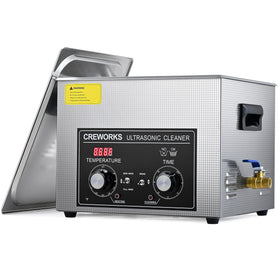
CREWORKS Professional 360W 15L Digital Ultrasonic Cleaner is an excellent ultrasonic cleaner for rust removal. It has a powerful cleaning capability with 360W of ultrasonic power, and 40 kHz sound waves provide perfect cavitation for seamless cleaning.
It is perfect for both small and large cleaning tasks thanks to its 15L basin. It offers optimal cleaning temperatures, and an intuitive control panel offers multiple features which make sure that ensure the teams don't get damaged during the washing process.
The cleaner is designed with a unibody stainless steel basin and non-skid rubber feet, which offer durability and stability during operation.
A common challenge people encounter with ultrasonic cleaning for rust removal is that the rust seems to return a short time after cleaning. This happens because the process of ultrasonic cleaning strips the tools back to bare metal, thus leaving them vulnerable to rusting again.
To prevent it from rusting again, you need to add a corrosion-resistant coating to the rusted items immediately after cleaning them in the ultrasonic cleaner. Try the following solutions:
Spray the items thoroughly with WD-40 after cleaning. WD-40 displaces moisture and leaves behind a thin protective film on metal surfaces. It is extremely effective because it blocks oxygen and humidity from reaching the metal.
It reacts with iron oxide (rust) and turns it into iron phosphate, which is more stable and less reactive. Not a standalone long-term solution, but sufficient for dealing with flash rust.
Some users recommend using diesel to prevent items from rusting after ultrasonic cleaning. Diesel does not mix with water, so you can pull the items out through the layer of diesel to coat them in oil and prevent rust. You’d have to blow out the extra oil later, though.
If using tap water in your ultrasonic cleaner, consider adding some corrosion inhibitor while cleaning rusted items. This will slow down the corrosion, even after cleaning.
An ultrasonic cleaner is a potential tool for getting the stubborn rust from your items. You can achieve impressive results by following the straightforward guidelines.
High-quality ultrasonic cleaners effectively restore the quality of your metal items, but it's important to follow the safety guidelines for safe and effective use. So give your equipment the shine they deserve.



Leave a comment