
Certified Business
With over 10000+ orders
With over 10000+ orders
A dehumidifier is not a major necessity in a garage, but it is a practical solution for dealing with humidity and other moisture-related problems that are common in garage spaces. In a garage, a dehumidifier plays four important roles: preventing rust and corrosion, controlling mold and mildew, protecting stored items, and reducing condensation.

There are five important factors to consider when choosing a dehumidifier size for a basement: the size of the garage (in square footage), the level of dampness, the quality of insulation and sealing, outside climate, and the ceiling height.
| Garage Size | Light Humidity | Moderate Humidity | Very Damp |
| 1-car (200–400 sq ft) | 30–40 pint | 40–50 pint | 50+ pint |
| 2-car (400–600 sq ft) | 40–50 pint | 50–60 pint | 60+ pint |
| 3-car (600–1,000 sq ft) | 50 pint | 60–70 pint | 70+ pint |
For most people, the biggest challenge with choosing a dehumidifier for a garage is finding one that is the right size.
Rule of thumb:
When in doubt, size up, especially for uninsulated or detached garages.

Compressor dehumidifiers are, overall, the best dehumidifiers for garages, especially attached and mild-climate garages. Overall, they tend to have high moisture removal capacity, are widely available, generally affordable, and are best for moderate to warm temperatures.
Look for a model with an auto-defrost function, low-temperature operation rating, and continuous drain option.
Desiccant dehumidifiers are also great for garages, especially unheated garages in cold climates. They perform well in cold climates, and there is a very low risk of their compressors freezing up. They are also known for being relatively quiet in operation.
The downsides of desiccant dehumidifiers, however, are that they use more energy and some models have lower moisture removal rates overall.
Industrial/ commercial refrigerators are best for larger garages and garages with severe moisture problems. You can also consider a commercial dehumidifier for a large garage or workshop. These usually feature:
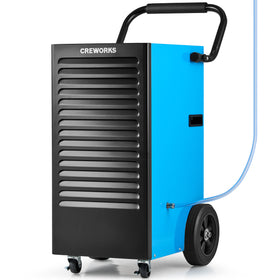
The downsides of industrial or commercial dehumidifiers are that they are expensive and may consume more power. An affordable model worth considering is Crework's 145 PPD Commercial Dehumidifier. Tailored for areas spanning from 800 to 2000 square feet, it is Ideal for garages, as well as basements and crawl spaces.
With upgraded condenser and evaporator coils, this crawlspace dehumidifier effectively eliminates 70 ppd at AHAM and an impressive 145 ppd at saturation, maintaining a reliably dry environment. Perfect for eliminating unpleasant odors, unhealthy mold, microbes, and uncomfortable dampness in a garage.
 Benefits of Garage Dehumidifiers
Garages often store tools, bikes, lawn equipment, power tools, and vehicles, all of which are sensitive to moisture. A dehumidifier in your garage helps prevent rust and corrosion in three ways:
Without a dehumidifier, moisture cycles daily with temperature changes, accelerating rust even if the garage “looks dry.”
Garages are rarely climate-controlled and often have poor airflow. Keep in mind that mold does not necessarily need standing water: persistent humidity alone is enough. A dehumidifier can help control mold and mildew by keeping the humidity below the 60% threshold that mold needs to grow.
The low humidity also reduces musty odors while protecting drywall, wood framing, and stored items.
If you are like most people, your garage doubles as a storage space for cardboard boxes, clothing, holiday decorations, paints and chemicals, and other items that need protection from moisture. Having a dehumidifier in there will help all these items in three main ways:
Condensation forms when warm air hits cooler garage surfaces, especially on metal doors, ceilings, and vehicles. A dehumidifier fights condensation in a garage by lowering the moisture in the air. This is important for reducing condensation because:

Creworks offers a variety of commercial dehumidifier models ranging in size/capacity from 145PPD-180PPD, and suitable for garages of different sizes from 600 to 1600 square feet. Depending on the level of moisture and the size of your garage, you can choose between the following top units:
This 180PPD professional dehumidifier effectively eliminates 85 PPD at AHAM and an impressive 180 ppd at saturation, maintaining a reliably dry environment.
It has a built-in drain pump and 16.4 ft. hose allow this under-house dehumidifier to automatically drain water up to 16.4 ft. away in any direction. The intuitive display panel ensures easy adjustment of the timer, humidity levels, and water drainage.
With upgraded condenser and evaporator coils, this 145 PPD Commercial Dehumidifier effectively removes 70 ppd at AHAM and an impressive 145 ppd at saturation, ensuring a reliably dry environment.
The included water pump allows proper water drainage, even to higher or farther locations. The detachable display panel ensures easy adjustment of the timer and humidity levels.
If moisture is causing damage or discomfort, a dehumidifier is usually justified.

If you’re not ready for a dehumidifier yet, these steps can help:
These help, but they don’t replace active moisture removal in humid environments.
Choosing a dehumidifier for a garage doesn’t have to be complicated. Focus on garage size, humidity level, temperature, and drainage options, and choose a unit designed to handle tougher conditions than standard indoor spaces.
When properly sized and matched to your garage, a dehumidifier can protect your tools, vehicles, and storage, and save you money in the long run by preventing moisture damage before it starts.
You might also be interested in the best dehumidifier settings for efficient and cost-effective use in different environments, including garages.



Leave a comment