
Certified Business
With over 10000+ orders
With over 10000+ orders
Ultrasonic gun cleaning not only works but is also much easier, time-saving, and overall more effective: instead of scrubbing for hours, you can let physics do most of the work for you. The ultrasonic cleaner uses high-frequency sound waves in a heated liquid to remove dirt and fouling from even the smallest crevices of your gun parts.
In this guide, we’ll cover:

Ultrasonic gun cleaning uses high-frequency sound waves in a liquid bath to create microscopic bubbles. These bubbles rapidly form and collapse in a process called cavitation. When they collapse, they release tiny bursts of energy that knock carbon, grease, and fouling loose from metal surfaces, including inside holes, channels, and tight internal parts.
The result is a level of cleaning that’s extremely hard to achieve with brushes, patches, and picks alone.
Modern firearms have:
These areas are notoriously annoying to clean manually. Ultrasonic cleaners are much more effective because the liquid infiltrates tight and hidden spaces that the naked eye cannot even see. If liquid can reach it, the cavitation bubbles can clean it.

The process of cleaning gun parts in an ultrasonic cleaner is quite simple: first, disassemble the firearm and place the parts into the ultrasonic cleaner, then run a cleaning cycle for about 10–15 minutes, depending on how dirty the components are.
Afterward, remove the parts and place them in an oil‑displacing solution for approximately 3–5 minutes. Finally, take the parts out, wipe them clean, reassemble the firearm, and apply proper lubrication.
Follow these steps to clean gun parts in an ultrasonic cleaner.
For ultrasonic gun cleaning, you can use alternatives like Simple Green or Purple Power, but keep in mind that these are not suitable for all gun parts. Specifically, they are not safe for anodised or coated parts. They can strip anodising from receivers and other components. They’re only safe for stainless steel parts.
You don’t have to disassemble every single gun part for ultrasonic cleaning, but the more you disassemble, the better the cleaning, and the quicker the process.
Any gun part can go into the ultrasonic cleaner except optics and electronic parts. The following gun parts can be cleaned in an ultrasonic cleaner:
Some ultrasonic cleaners come with magnetic baskets, allowing you to suspend a gun so the optic stays out of the liquid.

Lower the basket into the hot cleaning solution and set the timer for about 15 minutes
When the cleaning cycle finishes, lift the basket out. Recently cleaned gun parts, especially the metal ones, will be hot. So, don’t touch anything just yet.
Very dirty parts (like bolt carrier groups) may benefit from another 5–10 minute cycle. You can lightly brush off any remaining floating debris.
Some ultrasonic units include a second tank for water-displacing oil.
If your unit doesn’t have this, submerge parts in water-displacing oil or anti-corrosion fluid manually
This step removes moisture, prevents corrosion, and leaves a protective oil film over your gun parts.
And there you go. You have successfully cleaned multiple gun parts in a matter of just about 30 minutes or so.

For an ultrasonic gun cleaner, a basket is critical. You don’t want parts sitting on the bottom of the tank.
It must also have enough heating and cleaning capacity, a heater, a timer, and a digital control panel for effortless operation. It must have both a large basket and a tank for submerging the gun parts in oil or an anti-corrosion solvent.
The tank must be big enough to accommodate your gun parts. If you have many guns to clean, it is advisable to go for an industrial ultrasonic cleaner.

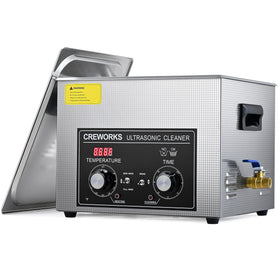
Creworks' 240W Ultrasonic Cleaner is one of the best ultrasonic machines for gun parts for sale. Its unique elongated design ensures efficient cleaning even for those narrow and hard-to-reach areas on delicate gun parts, heavy-duty auto tools, and intricate machine components.
Its 40kHz sound waves agitate the water in the 10 L (2.6 gal.) basin, creating cavitation that thoroughly cleans your items without the need for harsh chemicals or radiation.
With the 300W heating power, this ultrasonic cleaning machine provides even greater strength. The intuitive control panel provides timed cleaning for up to 30 minutes and heated cleaning at temperatures between 0 and 80°C (32 and 176°F).
| Feature | Ultrasonic Cleaning | Manual Cleaning |
| Cleaning depth | Reaches internal channels and hidden crevices | Limited to what brushes and picks can reach |
| Time required | 10–30 minutes mostly unattended | 30–120+ minutes of hands-on work |
| Effort | Very low | High |
| Consistency | Extremely consistent results | Depends on skill and patience |
| Risk of missed fouling | Very low | Moderate to high |
| Best for | Deep cleaning, heavily fouled parts, batch cleaning | Quick surface cleaning and spot maintenance |
| Equipment needed | Ultrasonic cleaner + solution | Brushes, patches, picks, solvents |
Ultrasonic cleaning is especially useful for:

Ultrasonic gun cleaning doesn’t replace all manual cleaning, but it dramatically reduces the time, effort, and frustration involved in keeping firearms in top condition. For deep cleaning, hard-to-reach areas, and heavily fouled parts, it’s simply in a different league.
Once you’ve used one, it’s very hard to go back to scrubbing everything by hand.



Leave a comment