
Certified Business
With over 10000+ orders
With over 10000+ orders
Many people are surprised to learn that plastics can be cleaned in an ultrasonic cleaner, but the majority of plastic items, from eyeglass frames to plastic automotive components, even to 3D printed parts, can be cleaned in an ultrasonic cleaner.
However, it is important to understand that not all plastics can be put in an ultrasonic cleaner, and that is because not all plastics can handle ultrasonic waves. While items like eyeglass frames will withstand the ultrasonic waves, weaker plastics (like foam) will crack, discolor, warp, or become brittle if exposed to excessive ultrasonic energy or heat.
Also, cleaning plastics in an ultrasonic cleaner needs to be handled with care: you must pay attention to the level of heat exposure, know how to deal with paint, and employ some measures to protect the plastic even as it is being cleaned.
A good approach to this topic is to start by understanding which plastics are suitable, how ultrasonic cleaning affects them, and how to clean them safely.

To most people, it seems quite strange that an ultrasonic cleaner should be able to clean items made of plastic. That is mostly because ultrasonic cleaners are famous for cleaning harder metal objects such as jewelry, tools, firearm parts, and machine components.
Plastics, on the other hand, are generally softer than metals, and they tend to be easily damaged by harsh chemicals or aggressive scrubbing.
However, the reason ultrasonic cleaning works so well on many plastics is that the ultrasonic cleaning process is generally very gentle on the surface of the items being cleaned. It is very effective at targeting the dirt, grease, and residue on the material, but ordinarily does not cause any harm to the material itself.
Let's start with how an ultrasonic cleaner works: an ultrasonic cleaner does not rely on brushes, scrapers, polishing compounds, or friction to remove dirt.
This process is incredibly effective on plastics: cavitation attacks the dirt, grease, oil, dust, residue, and contaminants, not the plastic itself. This allows ultrasonic cleaners to clean complex plastic parts without physically scrubbing them.
You can safely put most hard plastics (like ABS or polycarbonate) in an ultrasonic cleaner. Because they are harder and more compact, these can tolerate ultrasonic energy and the heat of the ultrasonic cleaner much more. However, low-density, flexible plastics (like LDPE) or painted plastics can easily be damaged in an ultrasonic cleaner.
Plastics that perform well in ultrasonic cleaners generally share five important characteristics. They typically have:
These properties are important because they help the material absorb the microscopic forces created by cavitation without developing cracks or structural damage.

Plastics that are brittle, heavily aged, chemically degraded, or prone to stress cracking are more vulnerable and should not be exposed to ultrasonic cleaning.
Also, some plastics may appear perfectly fine after one cleaning cycle but develop microscopic fractures that grow over time. This is particularly common in older plastic parts that have been exposed to sunlight, chemicals, or years of use.
| Plastic Type | Suitable for Ultrasonic Cleaning? | Notes |
| Polypropylene (PP) | Yes | Excellent chemical resistance and durability. |
| Polyethylene (PE) | Yes | Generally handles ultrasonic cleaning well. |
| High-Density Polyethylene (HDPE) | Yes | Commonly used in laboratory and industrial applications. |
| ABS Plastic | Usually Yes | Safe under moderate settings and temperatures. |
| Nylon (PA) | Yes | Frequently cleaned ultrasonically in industrial applications. |
| Polycarbonate (PC) | Usually Yes | Use lower temperatures and shorter cycles to prevent stress cracking. |
| Acetal (Delrin/POM) | Yes | Strong engineering plastic with excellent durability. |
| PVC | Usually Yes | Generally safe when mild cleaning solutions are used. |
| PET | Usually Yes | Safe for light cleaning applications. |
| Acrylic (PMMA) | Use Caution | Can develop fine cracks or become cloudy. |
| Polystyrene (PS) | Use Caution | Brittle and prone to cracking. |
| Expanded Polystyrene (Foam) | No | Easily damaged by ultrasonic energy and cleaning solutions. |
| Aged Plastic Components | Not Recommended | Existing stress and degradation increase cracking risk. |
| Brittle Vintage Plastics | Not Recommended | High risk of damage and cosmetic deterioration. |
| Certain 3D-Printed Resins | Use Caution | Depends heavily on resin type and curing quality. |
Most modern eyeglass frames tolerate ultrasonic cleaning well. In fact, plastic eyeglass frames are among the most commonly cleaned items in ultrasonic cleaners.
However, if you are going to put your plastic eyeglass frame in an ultrasonic cleaner, make sure it is not too old. Older frames, cracked frames, or frames made from specialty materials may weaken over time.
Also, if it is a particularly expensive brand, it is advisable to clean them in shorter cleaning cycles and at moderate temperatures.
3D-printed parts deserve special attention when it comes to ultrasonic cleaning. FDM-printed plastics such as PLA, PETG, and ABS often clean well, but Resin-printed parts can be more unpredictable. Poorly cured resin prints may become brittle or develop surface damage during ultrasonic cleaning.
So, when cleaning resin prints, always test on a non-critical sample first.

You always have to employ the proper cleaning practices when it comes to cleaning plastic in an ultrasonic cleaner, even if the plastic in question is considered compatible and suitable for ultrasonic cleaning. Following these ultrasonic plastic cleaning guidelines will dramatically reduce the risk of damage.
Heat is often more dangerous to plastics than ultrasonic energy itself. Thermoplastics like polycarbonate can melt or warp if the cleaning solution is too hot. So, keep the temperature of the solution moderate.
For most plastic items, temperatures between 30°C and 45°C (86°F and 113°F) are typically sufficient. When in doubt, use lower temperatures.
The type of ultrasonic cleaning solution you use matters when you are cleaning plastics. Generally, strong alkaline cleaners, aggressive solvents, and harsh degreasers are a risk: they can damage plastics even when the ultrasonic cleaner itself is not causing problems.
So, for plastics, stick to ultrasonic cleaning solutions specifically designed for plastics, or for electronics, eyewear, and general-purpose ultrasonic cleaning.
The vibrations in the ultrasonic cleaner can cause items resting against the stainless steel basket to rattle and scratch. Using a plastic mesh tray or putting your parts in a bag filled with a mild soap/water mixture helps protect the plastic and keeps your cleaning tank pristine.
How long you clean plastics in an ultrasonic cleaner also matters a lot. Many plastic items can be cleaned effectively in just a few minutes, and leaving them in there for longer may constitute a risk.
2-5 minutes is the standard cleaning time for many plastic items in an ultrasonic cleaner, but you can adjust based on the level of contamination.
This approach reduces unnecessary exposure to ultrasonic energy.

Plastics often benefit more from precision than brute force. So, when you are buying an ultrasonic cleaner for plastic items, the focus should be on the level of precision and control you can achieve from its functions, rather than on how powerful it is.
A good plastic-friendly ultrasonic cleaner should offer:
The ideal ultrasonic cleaner for plastics should provide controlled cleaning rather than maximum cleaning intensity. The goal is controlled cleaning that removes contamination without overstressing delicate materials.
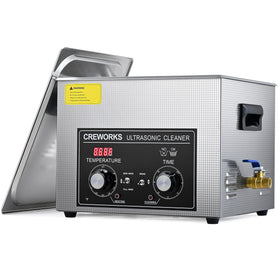
Creworks' ultrasonic cleaners feature industrial-grade transducers, which provide greater cleaning power and reliability. They come with a 304 stainless steel casing, ensuring safety and easy cleaning. With both digital and manual knob models, you can ensure thorough and gentle cleaning by precisely controlling cleaning time and temperature, effectively removing dirt without damage. These cleaners are effective not just for plastic items but also for various items such as dentures, jewelry, and lenses, delivering outstanding results.
So, can you put plastics in an ultrasonic cleaner? In many cases, absolutely. By using mild cleaning solutions, moderate temperatures, shorter cleaning cycles, and a quality ultrasonic cleaner with adjustable controls, you can safely clean many plastic components while achieving professional-level results.
The key is understanding that not all plastics behave the same way. Durable engineering plastics such as polypropylene, polyethylene, nylon, ABS, and acetal generally perform very well, while brittle, aged, or stress-sensitive plastics require greater caution.
You may be interested in our guide on how to clean an ultrasonic cleaner for long-term use.




Leave a comment